Home  ›  Articles  ›  BOPP Packing Tape
Manufacturing in Sharjah since 1991

BOPP Packing Tape — The Science Behind Reliable Carton Sealing

Premium BOPP packing tape is not simply a film coated with glue. It is an engineered system in which the film, the surface treatment and the adhesive formulation work together. Tape quality should never be judged by adhesive coating weight or total thickness alone.

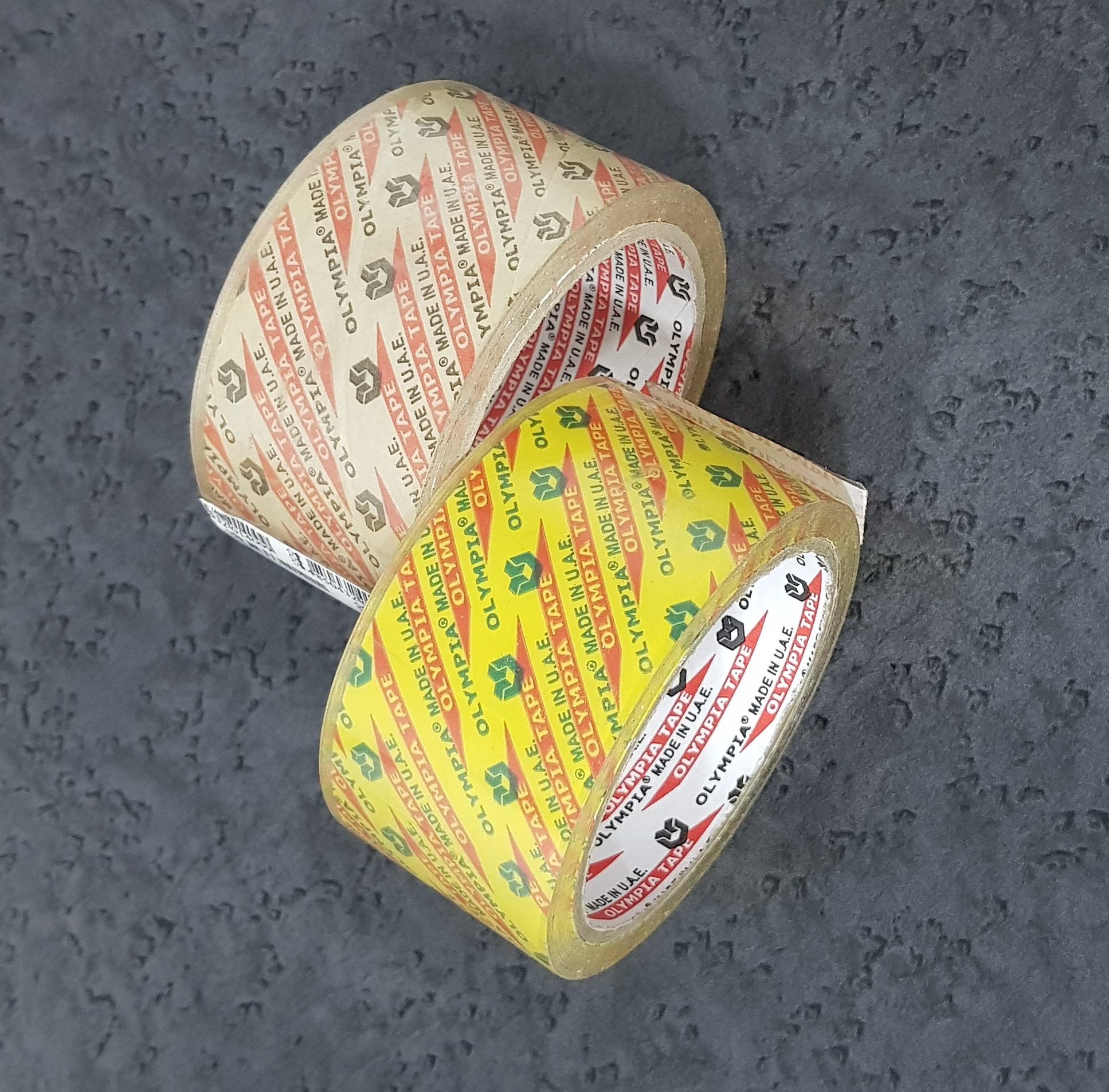
Olympia branded BOPP carton sealing tape rolls manufactured in Sharjah, UAE
Olympia BOPP carton-sealing tape, produced at our Sharjah facility

Quality is more than thickness

When buying BOPP packing tape, it is common to compare products by micron thickness, roll length, adhesive coating weight and price. These numbers alone do not tell the complete story.

A high-quality packing tape is an engineered combination of the right BOPP film, the correct film thickness, proper corona treatment, the right adhesive chemistry, the correct coating weight, good adhesive anchorage, a proper balance of tack, peel, adhesion and cohesion, controlled coating uniformity, and correct curing and converting conditions.

A tape can have a thick film and still perform poorly. It can also carry a very high adhesive coating weight and still fail.

The objective is not to put the maximum amount of adhesive onto the film. It is to create the correct balance between film strength, adhesive coating and adhesive properties for the application.

The four elements of a reliable tape

01

BOPP film

Provides the mechanical strength, dimensional stability and backbone of the tape.

02

Corona treatment

Creates the surface characteristics needed for effective adhesive anchorage to the film.

03

Adhesive

Creates the actual bond between the tape and the carton — the working part of the tape.

04

Optimised coating

Provides the right quantity of adhesive for the selected film and the intended application.

Right film+ Right corona+ Right adhesive+ Right coating= Reliable tape

Changing only one of these elements without considering the others can compromise the final product.

BOPP film tensile strength · clarity Corona treatment ≈38–42 dynes/cm Adhesive tack · peel · cohesion Corrugated carton rough · dusty · variable Two interfaces must both hold: film ↔ adhesive and adhesive ↔ carton
The complete tape construction. A failure at either interface compromises the whole tape.

Why BOPP is the preferred backing

BOPP — Biaxially Oriented Polypropylene — is widely used for carton-sealing tape because the orientation process gives the film the mechanical properties needed to withstand the tension generated during application, carton handling and converting.

But there is an important point: BOPP itself is not the adhesive. Polypropylene is naturally a low-surface-energy, non-polar material, so adhesives do not automatically bond strongly to untreated BOPP. Surface treatment is therefore a critical part of producing reliable tape.

Selecting the film

A thinner film may be perfectly suitable for light-duty cartons. A heavier film may be required where the tape faces high application tension, heavy cartons, long transport distances, rough handling, automated carton sealing, export logistics or high-temperature storage. Film thickness should be selected according to the mechanical requirement of the application — not simply the lowest possible cost.

Corona treatment: the invisible foundation

One of the most frequently overlooked specifications in BOPP tape is the corona treatment on the adhesive side of the film. Corona treatment modifies the surface of polypropylene by introducing polar functional groups and increasing surface energy, which improves wetting and allows the adhesive to anchor far more strongly.

In practical tape production, the adhesive side of tape-grade BOPP is commonly supplied in the region of approximately 38–42 dynes/cm, although the appropriate specification depends on the adhesive system and film supplier.

WITHOUT PROPER TREATMENT low surface energy Adhesive beads up — poor wetting ↓ Weak anchorage ↓ Adhesive transfer ↓ Delamination ↓ Edge lifting WITH PROPER TREATMENT ≈38–42 dynes/cm Adhesive wets and spreads evenly ↑ Strong anchorage ↑ Uniform coating ↑ Clean removal ↑ Reliable construction
Surface energy determines whether the adhesive can wet and anchor to the film at all.

The number is not the whole story

Corona treatment is not simply a figure to be printed on a specification sheet. What matters is the correct treatment level, treatment uniformity, treatment stability, treatment retention and compatibility with the selected adhesive. Surface treatment can decrease over time, so film storage conditions and age should be considered.

The right adhesive on the wrong film is still the wrong tape.

The adhesive is the working part of the tape

The BOPP film carries the tape. The adhesive does the bonding. When the tape is applied to a carton, the adhesive must:

  1. Contact the carton surface
  2. Wet the surface
  3. Flow into surface irregularities
  4. Develop adhesion
  5. Maintain internal strength
  6. Remain anchored to the BOPP film

This is why two tapes with the same specification on paper — 48-micron BOPP + 20 GSM adhesive — can perform very differently. A professional adhesive system must balance four key properties.

"How quickly does it grab?"

Tack

The adhesive's ability to make an immediate bond on first contact. Critical at high sealing speeds, short contact times and on rough carton surfaces.

"How strongly does it stay attached?"

Peel adhesion

The force required to remove the tape from the carton — an important indicator of how strongly the adhesive has bonded to the substrate.

"Does the adhesive hold itself together?"

Cohesion

The internal strength of the adhesive. Without it, the adhesive layer can split during removal, leaving residue on the carton and film alike.

"How well does it bond to the carton?"

Adhesion

The interaction between the adhesive and the actual packaging surface — and cartons vary significantly in surface quality.

Tack ≠ adhesion ≠ cohesion

These terms are sometimes treated as though they mean the same thing. They do not. A tape with high tack and poor cohesion can feel extremely sticky during application while still failing on removal. A tape with high cohesion and insufficient adhesion stays together but does not adequately bond to the carton. Increasing one property without considering the others does not produce a better tape.

The most important misconception: more adhesive ≠ stronger tape

A common purchasing assumption is: "If 18 GSM adhesive gives good performance, 25 GSM must be stronger." Not necessarily. Adhesive performance is not simply proportional to coating weight.

The adhesive needs enough coating to wet the carton surface, fill surface irregularities, develop sufficient contact area, provide the required peel and tack, maintain cohesive integrity and remain properly anchored to the BOPP. But beyond the optimum range, simply increasing coating weight creates new problems.

WHEN TOO MUCH ADHESIVE MEETS TOO THIN A FILM thin BOPP excess adhesive stress → carton ADHESIVE LAYER SPLITS Adhesive remains on the film Adhesive remains on the carton
Adhesive splitting, or glue transfer — the customer sees glue left on the carton while the tape has lost part of its adhesive layer. This is not a stronger tape; it is an unbalanced construction.

Unbalanced construction

Very thin film + excessive adhesive. Higher material cost, adhesive splitting, transfer, poor balance and unnecessary adhesive consumption — while feeling impressively sticky by hand.

Balanced construction

Correct film + correct adhesive + optimised coating. Reliable tensile strength, good initial tack, strong carton adhesion, good cohesive integrity, cleaner removal and consistent application.

The second construction can deliver better functional quality even though it uses less adhesive. The correct objective is optimum adhesive coating for the selected film and application.

Adhesive technologies

There is no universal adhesive that is best for every packaging application. Each system has a profile, and the correct selection depends on the application, carton, temperature, storage, speed, required bond and service conditions.

Water-based acrylic

Acrylic polymer particles are dispersed in water; after coating, the water is removed through controlled drying. Acrylic systems are valued for good aging stability, UV resistance, clarity, low odour relative to many solvent systems, long-term adhesion and resistance to yellowing. Modern modified acrylics can also provide good quick-stick and all-temperature performance when properly formulated — commercial acrylic carton-sealing tapes are available with specified operating ranges extending roughly from 0 °C to 65 °C, which shows that performance depends strongly on formulation rather than on adhesive family alone.

Water-based does not mean weak. A properly formulated acrylic adhesive, combined with the correct BOPP and coating weight, provides reliable long-term carton-sealing performance for general sealing, warehousing, e-commerce, long-term storage, export packaging and transparent tape.

Solvent-based

Solvent-based systems use a solvent carrier for the adhesive polymer, removed during coating and drying. They can be engineered for demanding combinations of aggressive tack, high adhesion, good wetting, temperature performance and performance on difficult substrates — particularly useful where the packaging surface is harder to bond to. However, they require careful attention to solvent handling, drying efficiency, VOC management, fire and explosion safety, environmental regulations, residual solvent control and production-line design.

Solvent adhesive should not be selected simply because it sounds "stronger." The adhesive system should be selected according to the required performance profile and the manufacturing process.

Hot-melt

Hot-melt provides very high initial tack, fast bonding, good immediate grab and strong high-speed application performance — attractive for automatic carton sealing where the carton must be secured immediately. However, hot-melt systems are thermoplastic by nature, so temperature significantly affects adhesive behaviour.

PropertyWater-based acrylicSolvent-basedHot-melt
Initial tackModerate to high*High*High to very high*
Long-term agingExcellent*Good to excellent*Formulation dependent
UV resistanceGenerally very goodFormulation dependentMore formulation dependent
Heat performanceGood to excellent*Good to excellent*Highly formulation dependent
Immediate grabModerate to high*High*Very high*
OdourGenerally lowSolvent-relatedGenerally low after application
VOC considerationsLowerHigher process considerationGenerally low during use
High-speed sealingExcellent with suitable gradeExcellent with suitable gradeExcellent
Hot-climate suitabilityExcellent with suitable formulationApplication dependentRequires careful formulation
Typical positioningGeneral / long-term packagingSpecialised performanceHigh initial tack / fast bonding

*Performance varies significantly with formulation, coating weight, film construction, carton substrate and test conditions.
Why hot-melt needs careful evaluation in the Middle East

Packaging used in the Middle East encounters demanding temperature conditions during warehouse storage, container storage, road transportation, outdoor loading, closed vehicles, port handling and long-distance distribution.

Many conventional hot-melt packing-tape adhesives are based on thermoplastic rubber and resin technology. Because their performance depends strongly on temperature, elevated storage temperatures can change adhesive modulus, tack and cohesive behaviour. At elevated temperatures an inadequately designed hot-melt may soften, lose cohesive strength, migrate, or show increased adhesive transfer.

Excellent initial tack at application does not automatically mean excellent long-term performance at elevated temperature.
A tape can pass a factory test and still meet very different conditions afterwards Factory Warehouse Truck Port /Container Importwarehouse Distribution Finalcustomer At every stage the tape sees different temperature, humidity, handling force and storage duration Specify for the whole journey — not just the sealing machine
Tape selection for Middle Eastern markets must consider heat exposure and storage life, not only application performance.

The important question is not "Does hot-melt have high tack?" but "Will this particular hot-melt formulation maintain the required adhesion and cohesive strength throughout the customer's actual temperature profile?"

For hot-climate applications, a properly formulated water-based acrylic system can often provide a more stable long-term solution where heat aging, UV exposure and storage stability are priorities. General comparative data likewise show higher initial tack for hot-melt while acrylic generally offers stronger aging and UV characteristics. The final choice should always be validated against the actual temperature profile and application requirements rather than assuming one chemistry is universally superior.

The carton is part of the system

Tape does not bond to an abstract laboratory surface. It bonds to a real carton — and corrugated cartons vary considerably:

  • Kraft liner quality
  • Recycled fibre content
  • Surface roughness
  • Dust
  • Printing ink
  • Coatings
  • Wax or surface treatments
  • Moisture
  • Temperature
  • Fibre strength

A tape designed for a clean, smooth carton can behave very differently on a dusty recycled carton. This is why a tape that performs perfectly in one market may behave differently in another — and why performance should be evaluated against the actual carton substrate.

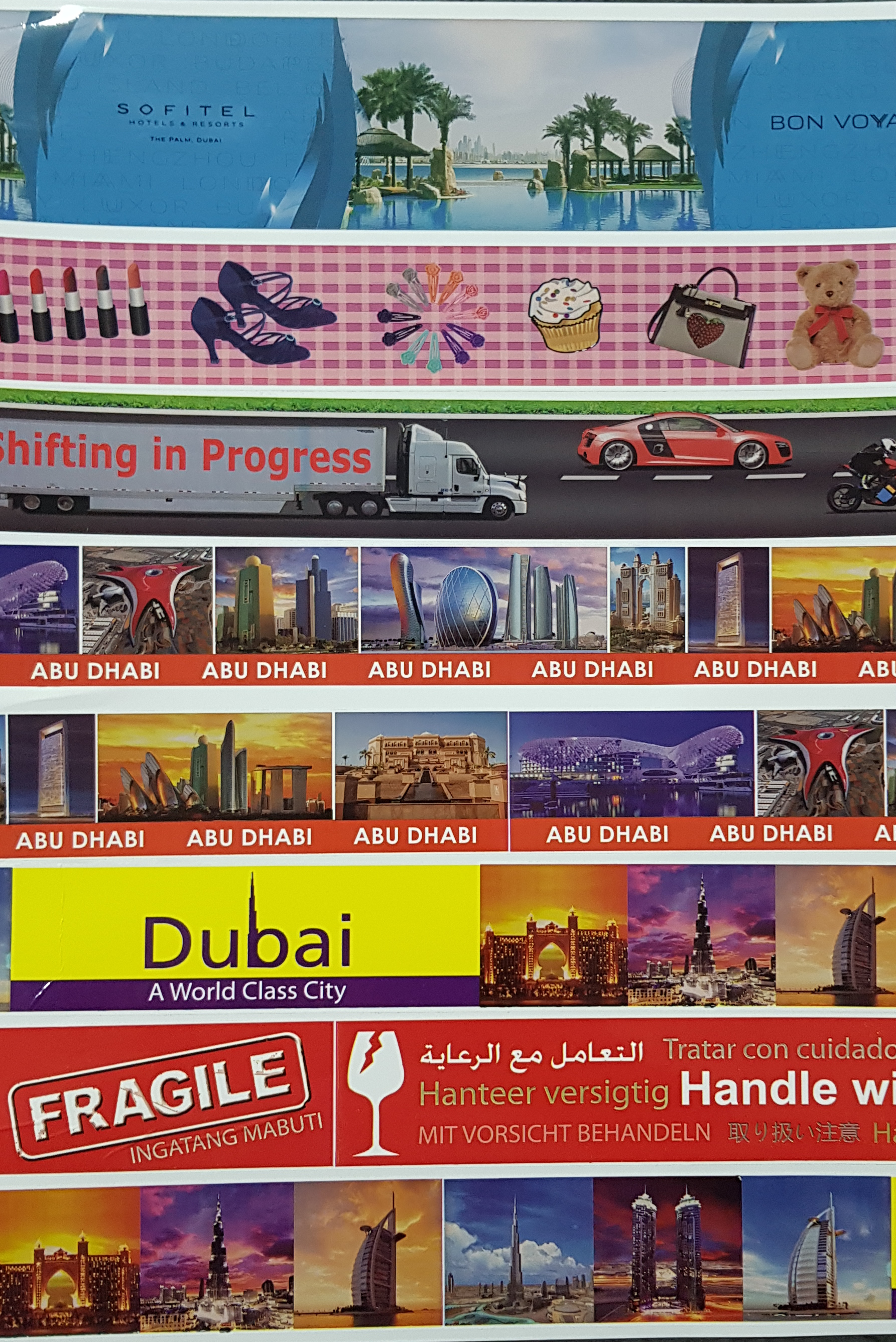
High-resolution multi-colour printed BOPP carton sealing tape produced by Olympia Industries
Coating and print uniformity are controlled throughout the run

The BOPP tape quality pyramid

LEVEL 5 — APPLICATION carton · temperature · speed · storage LEVEL 4 — COATING OPTIMISATION correct amount of adhesive for the construction LEVEL 3 — ADHESIVE CHEMISTRY tack · peel · adhesion · cohesion LEVEL 2 — CORONA TREATMENT surface preparation and adhesive anchorage LEVEL 1 — BOPP FILM mechanical strength and dimensional stability RESULT: RELIABLE CARTON SEALING
Each level depends on the one beneath it. Weakness at any level limits the finished tape.

Common misconceptions

Myth 01

"More adhesive means stronger tape."

Fact

More adhesive does not automatically mean better performance. Excess coating can create an unbalanced construction and may contribute to adhesive splitting or transfer.

Myth 02

"Thicker tape is always better."

Fact

Film thickness should match the mechanical requirements of the application. A 50-micron tape is not automatically better than a 45-micron tape.

Myth 03

"Higher tack means better adhesive."

Fact

Tack is only one adhesive property. Cohesion, peel and adhesion are equally important — and a high-tack, low-cohesion tape fails on removal.

Myth 04

"Any BOPP film can be coated with any adhesive."

Fact

Film surface characteristics and corona treatment must be compatible with the selected adhesive system.

Myth 05

"Hot-melt is automatically the strongest adhesive."

Fact

Hot-melt can provide excellent initial tack, but its suitability depends on formulation, temperature and the required long-term performance.

What a professional buyer should specify

Instead of specifying only "48 micron tape" or "20 GSM adhesive", a professional specification considers the complete construction.

Film

BOPP thickness · tensile strength · elongation · dimensional stability · clarity · film quality

Surface

Corona treatment level · treatment uniformity · treatment retention · adhesive compatibility

Adhesive

Chemistry · coating weight · tack · peel adhesion · cohesion · anchorage · temperature and aging performance

Finished tape

Total thickness · roll length · roll appearance · unwind behaviour · carton adhesion · storage stability

Product development checklist

For every new tape construction, validate:

Technical note. The performance of BOPP packing tape depends on the specific film grade, adhesive formulation, coating weight, corona treatment, carton substrate, application method, temperature, humidity and storage conditions. Values and comparisons presented here are general technical guidance and should not be interpreted as universal specifications for every adhesive or tape construction. Final product specifications should be established through laboratory testing and validation under your actual application and environmental conditions.
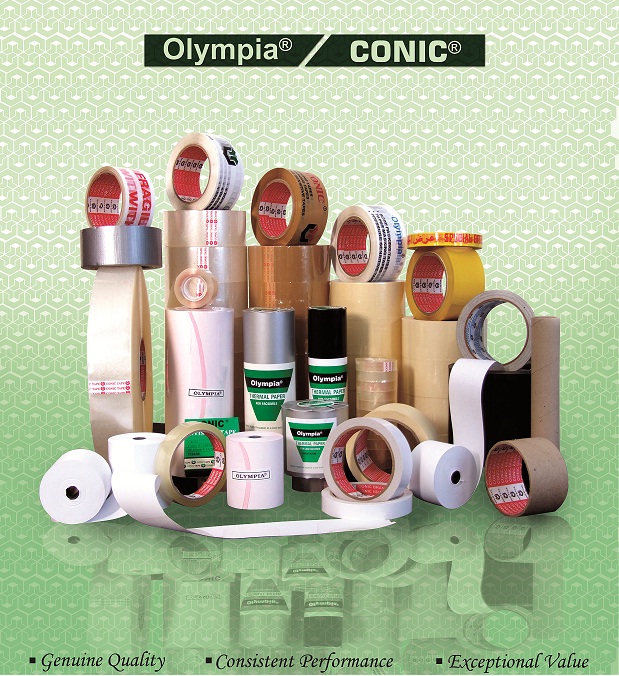
The complete Olympia and Conic range of adhesive tapes, thermal rolls and labels made in Sharjah
The complete Olympia / Conic range, made in Sharjah

Quality is a balance

The BOPP film provides the backbone. Corona treatment prepares the surface. The adhesive creates the bond. The coating weight determines how much adhesive is available to perform that function.

But quantity alone does not create quality. A thin film overloaded with adhesive can create an apparently sticky tape while increasing the risk of adhesive splitting and transfer. A properly engineered film with correctly selected corona treatment, adhesive chemistry and optimised coating delivers significantly better functional performance, consistency and reliability.

We believe professional BOPP packing tape should be engineered rather than simply manufactured — and for demanding markets where high temperatures and long storage periods are involved, the tape must be designed around the customer's real operating environment.

Performance before coating weight
Balance before extremes

Frequently asked questions

Is a higher adhesive GSM always better?

No. Adhesive performance is not proportional to coating weight. The adhesive needs enough coating to wet the carton, fill surface irregularities and develop peel and tack — but beyond the optimum range, extra coating can reduce the balance of the construction and contribute to adhesive splitting or transfer. The right objective is optimum coating for the selected film and application.

What is corona treatment and why does it matter?

Corona treatment modifies the surface of the BOPP film, raising its surface energy so the adhesive can wet and anchor properly. Tape-grade BOPP is commonly supplied around 38–42 dynes/cm on the adhesive side, depending on film and adhesive. Without adequate treatment the adhesive may transfer off the film, delaminate or lift at the edges.

Which adhesive is best for the UAE and hot climates?

There is no universally best adhesive. Where heat aging, UV exposure and long storage are priorities, a properly formulated water-based acrylic system often provides a more stable long-term solution. Hot-melt offers higher initial tack but is more temperature-sensitive and needs careful formulation for hot storage. The choice should be validated against your actual application and temperature profile.

What is adhesive transfer or adhesive splitting?

It is when the adhesive layer fails internally rather than at a surface — part of the adhesive stays on the carton and part stays on the film. It usually indicates insufficient cohesive strength or inadequate anchorage for that construction, and is often seen where a thin film carries a disproportionately heavy adhesive coating.

Is a 50-micron tape better than a 45-micron tape?

Not automatically. Film thickness should match the mechanical requirement — application tension, carton weight, transport distance, handling, automated sealing and storage temperature. What matters is the complete construction, not any single figure.

What should I ask for when specifying tape?

Beyond micron and GSM, ask about film tensile strength and elongation, corona treatment level and uniformity, adhesive chemistry, and the four adhesive properties — tack, peel, cohesion and adhesion — together with temperature and aging performance for your storage conditions.

Specify your BOPP tape with us

Tell us your carton type, sealing method, application speed, storage temperature and how long the cartons sit before delivery — and we will recommend the film, adhesive system and coating weight that suit your actual conditions. Olympia Industries has manufactured adhesive tapes in Sharjah since 1991.

Also read: Printed Packing Tape →   ·   Printed Thermal Rolls UAE →